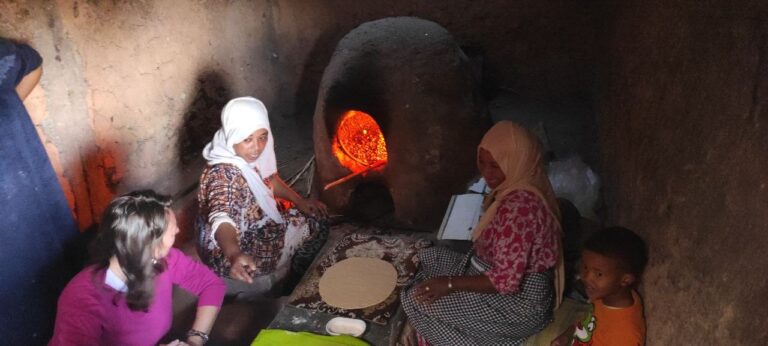
One of the first things that strikes you about Morocco is the multitude of smells that surround you. Some call it “the land of the senses”: smell first of all, but also sight, with its countless colors of fabrics and spices; hearing, with the shouts of the souks and the melodies of snake charmers; taste, satisfied by the specialties of Moroccan cuisine; and touch, through experiences you literally get your hands on.
Moroccan women cook all day, but above all, between meals, they devote themselves to the precious, symbolic art of making tea. Steeped in artistry and a ritual magic perhaps without equal, the Moroccan tea ceremony is a deeply fascinating experience, even if you witness it hundreds of times.
During your trip to Morocco you’ll be offered countless glasses of mint tea, and don’t you dare refuse! This gesture is much more than a thirst-quencher, because for Moroccans it’s a true statement of intent: you are my guest, I want to welcome you into my home, you are welcome here, I offer you my friendship, I treat you warmly, I share my tradition with you.
By tradition, offering this sweet Arab nectar is an invitation that is both intimate and communal, a sharing that opens the door to hospitality. In fact, from the very first time I was offered a glass of tea (or rather three glasses, but I’ll explain that later), I immediately felt part of that community. And that’s exactly the purpose of the Moroccan tea ceremony: to create a sense of belonging you won’t find anywhere else in the world.
The Moroccan tea ceremony: a history that symbolizes hospitality
Tea has been drunk in Morocco since the reign of Moulay Ismail (1645–1727), when it was given to him by Queen Anne of Great Britain in gratitude for releasing some British prisoners. But it wasn’t until the mid-19th century that tea became truly popular. During the Crimean War, the Baltic ports were closed, leaving English merchants with huge stocks of Chinese tea. Looking for new markets, they began selling it in the Moroccan ports of Tangier and Essaouira. At first only the upper classes could afford it, but between the late 19th and early 20th centuries it became affordable for everyone.
From then on began the history of the Moroccan tea ritual, a ceremony called Atay Naa Naa, which symbolizes hospitality par excellence.
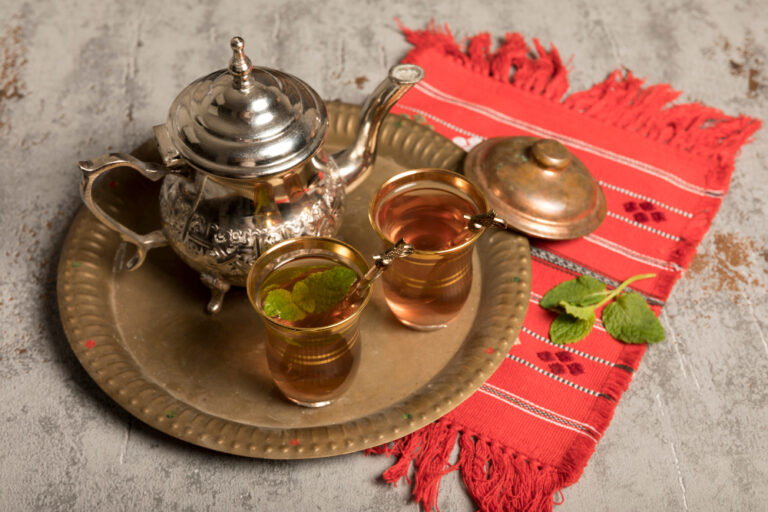
I don’t want to describe the ceremony in detail, because I promise that seeing it for yourself is truly priceless, but I do owe you a few tips for general knowledge. First of all, whenever I talk about Moroccan tea, I mean mint tea, made by mixing green tea leaves (usually the Chinese Gunpowder variety), nana mint (naa naa in Moroccan Arabic, a particularly sweet, aromatic variety) and plenty of sugar.
Mint has always been grown in Morocco, which is why it’s used so much, both as an infusion and as an ingredient in cooking.
While in Italy and much of the West we’re used to drinking coffee, in Morocco you’ll be struck by how many occasions and places involve tea. It’s sipped several times a day, certainly after every meal but, more generally, during any conversation. Wherever you are, at home, in shops, at the market or in the street, you’ll be offered tea, served piping hot in small decorated glasses, filling every corner with the pleasant, fresh scent of mint.
Tip time: there’s really no point looking for “the best place to drink Moroccan tea” or the like, because the preparation is the same everywhere, with the same ingredients and the same ritual, whether you’re in a private home, in the street or in the most luxurious resort. Taste it wherever it’s offered (even in the souks, in the middle of haggling, as a pure gesture of friendliness) and you won’t be disappointed.
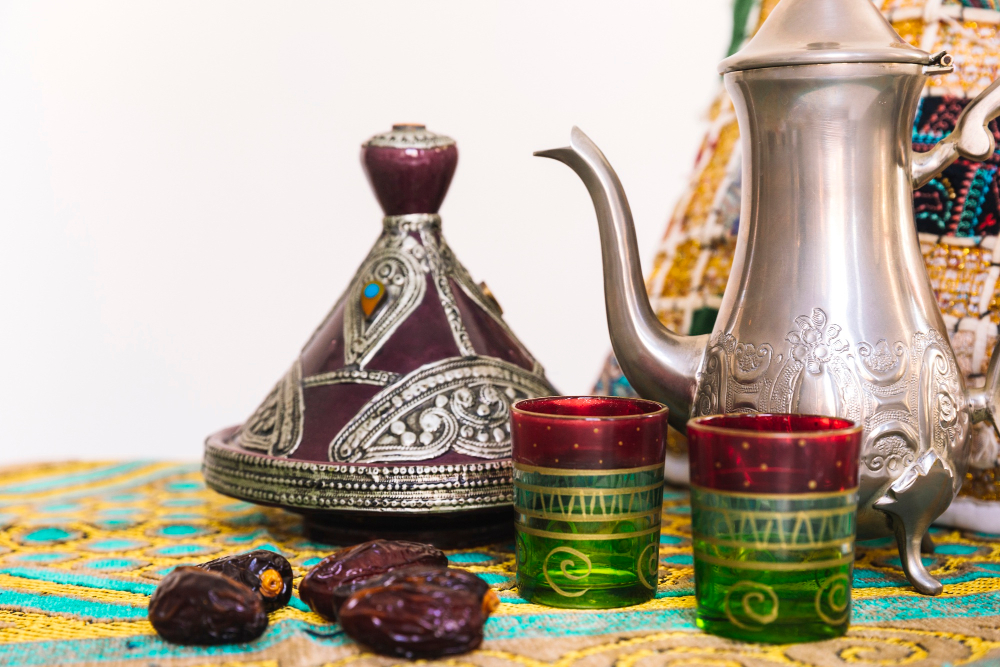
Offered tea in Morocco? Drink it!
Now for a few more details. The Moroccan tea ceremony is so fascinating precisely because it’s marked by measured, noble gestures, slow and almost choreographed. The head of the family or the oldest, most respected person in the house has the honor of making the tea in front of the guests, placing the teapot and glasses on a silver-plated metal tray. Glass is used rather than the ceramic or porcelain cups we’re used to, because it lets heat escape faster, so you can drink the infusion while it’s still hot without having to blow on it or wait long.
What will catch your eye most is the way the tea is poured. The host holds the teapot high, about 40 cm (16 inches) above the table, to aerate the infusion, enhance its flavor and create a thin layer of foam on the surface. A true ritual, symbolic art.
And now for the best part, the most traditional and meaningful, the one you absolutely must know to avoid seeming rude or disrespectful. Guests are served tea three times. Each time, as the brewing time gets longer, the tea will taste different.
An Algerian/Tuareg proverb puts it this way: “The first glass is gentle as life, the second glass is strong as love, the third glass is bitter as death“. Needless to say, you should drink all three, as a sign of abundance and good luck.
If you have the chance to meet the Berber nomads of the Atlas or spend a night in the desert, the tea utensils will probably be more modest (an enameled metal teapot set straight on the fire and plain glasses) and the preparation will be different too. You might also taste Saharan tea, made by the nomadic communities of the Sahara when fresh mint is scarce, with more green tea and an extremely concentrated, strong and bitter taste. Either way, the infusion will be a lovely expression of traditional sharing.
In imperial cities like Fez and Meknes, or for special ceremonies, a few drops of orange blossom water or rosewater are added straight to the teapot for an extra touch of delicate fragrance. In the Moroccan countryside, it’s also common to replace or combine mint with wild herbs (sage, thyme, lemon verbena or geranium petals). And in winter, when fresh mint is hard to find, Moroccans use chiba, or wormwood, an aromatic plant with a slightly bitter, more intense herbal flavor and balsamic, slightly spicy notes, perfect for warming and invigorating in the cold season.
What’s that? You’re going to Morocco in summer and don’t plan to drink hot tea? That’s a myth to bust right away! Mint tea is refreshing and thirst-quenching even when served hot in scorching temperatures, perfect for beating heat and thirst. The hot drink actually helps your body regulate its temperature, and it’s rich in minerals. Nothing beats it after a good trek.
Mint tea is also said to be invigorating, to ease nausea, calm the mind and reduce stress, aid digestion and bloating, and clear the airways (which you may really need after a walk in the desert). I’m no doctor, but you don’t need a degree to know how good it is to share a glass of tea (or rather three!) with the Moroccan people.
Lisa