During our tours in Morocco, we often have the chance to meet local people. People with their own past, their own stories and their own traditions. People who have things to tell us, anecdotes to share and customs to pass on.
Today we’re going to talk about one of those customs. It’s one you’ll probably notice yourself once you come to Morocco and venture beyond the cities: an ancient Berber tradition rooted in symbolism. We’re talking about Berber tattoos, or more accurately, Amazigh tattoos.
The origins of Amazigh symbolism
Let’s start at the beginning, and above all with that word: Amazigh.
The meaning is simple. Amazigh is the name the Berbers use for themselves. The word “Berber” comes from outside the culture, probably dating back to the ancient Greeks and Romans, who called foreigners “barbarians,” the term from which “Berber” derives. Amazigh (plural Imazighen), on the other hand, is the name the people themselves use, especially in certain parts of North Africa.
With that important note out of the way, let’s talk about tattoos, and before that, about why symbolism matters so much to the Imazighen.
Symbolism has deep roots among the Imazighen, going back to the dawn of time. It was used for four main purposes:
- To express their identity
- To show that they belonged to a particular tribe or social group
- For protection or healing
- In their sacred rituals
Where symbolism was used
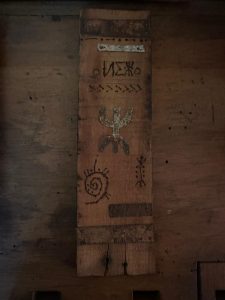
Symbolism was so important that it appeared in many areas of Amazigh daily life. You could find it on pottery, rugs, jewelry, buildings and furniture. But you could also find it on the body itself, as the Imazighen were (and still are) in the habit of tattooing symbols of many kinds, each with its own meaning.
Berber tattoos: rituals and history
If symbolism is fundamental to Berber culture, tattoos are (or rather, were) its highest form of expression. Tattooing is an ancestral and deeply meaningful ritual in Amazigh culture, serving as a primary means of symbolic, identity-related, healing and even decorative expression, much like tattoos today.
Unfortunately, this once-widespread practice (so widespread that there were specialized female tattoo artists, the Hadjaman, and male ones, the Ousham) is gradually disappearing. Colonization and the progressive Islamization of North Africa have played a part, since many Muslims consider tattooing haram, meaning forbidden.
Even so, there are still areas where the practice survives, and where most women bear tattoos made by their mothers or grandmothers.
Amazigh symbols and their meanings
Broadly speaking, the functions of these symbols fall into two main groups.
Spiritual functions
The Imazighen believe in a supernatural energy called baraka, and tattoo designs are thought to hold this sacred energy. It serves to ward off dark forces, cure illness and protect against spirits (jnoun).
Earthly functions
Wedding tattoos, tattoos for women widowed by war and tattoos identifying one’s tribe are just a few examples of tattoos with a practical, “earthly” purpose: a tangible function meant to identify members of the community and their relationships with one another.
Getting more specific, it’s actually very difficult to know the meaning of every symbol, for several reasons:
- Different tribes gave different meanings to similar symbols.
- Many meanings have been lost over time, since the tradition was passed down mostly by word of mouth.
- Some symbols were purely decorative and never had a specific meaning.
Still, we’ve been able to trace the meaning of some symbols (or at least the meaning they held for certain tribes). Here are a few that can still be found on textiles, houses and, of course, as tattoos on people who keep the tradition alive.
Moon and stars
In its various forms, this symbol represents a woman (the moon) with her children (the stars).
Honeycomb
A symbol of movement: its shape suggests flight and rotation. It is associated with nomadic life.
The swallow
A symbol of femininity and fertility, a theme of great importance in ritual life as well.
Flight
A symbol of constant movement representing life in all its fullness. It stands for strength, courage and intensity, and is also used as protection against evil spirits.
Palm trees
Another fertility symbol. Palms tattooed on the foreheads of Amazigh women (Timazighin) invoke the mother goddess, linking the palm’s dates to the birth of a child.
The tree of life
Often depicted not as a tattoo but on the central beam of the home, symbolizing the strength and unity of the family.
The lizard
Associated with spiritual enlightenment, and a symbol of friendship, hospitality and peace.
The partridge eye
The ultimate symbol of femininity, standing for beauty and agility. Very common, especially in Amazigh rug designs, it also represents the womb.
The snake
One of the oldest and most widely used symbols, in its many forms. It represents life in its most primal state, a great force that makes our world fertile.
The spider
A feminine symbol representing the sun, as well as patience and a hardworking, harmonious life.
The tree
Its branches represent life and its leaves represent knowledge. It is a symbol of happiness and fertility, the axis around which all beings and spirits revolve.
Where berber tattoos appear on the body
Berber tattoos are usually found on different parts of the body, each with its own name:
- On the chin, they are called Siyala.
- Between the eyebrows, they are called Ghemaza.
- On the forehead, they are called Ayach.
- Finally, there are Chaouia tattoos, from Algeria.
Final thoughts on berber tattoos
Amazigh symbolism is a cultural treasure, rich in meaning and millennia-old traditions. Despite the challenges of preserving and interpreting it, its influence endures. It bears witness to the richness and diversity of North African culture, and to the determination of its peoples to keep their traditions alive, even through a symbolism that may seem abstract and at times hard to decipher, but that actually holds a wealth of meanings and nuances.
I hope you enjoyed this deep dive into Berber tattoos and their symbolism, and that it added something to your knowledge of the subject. If so, feel free to share this article on social media and, if you don’t already, follow me on Instagram, where I often post many more fun facts in bite-sized form!
If you’d like to explore Berber symbolism further, here’s an affiliate link to a book in English that covers the topic in a simple, clear way: [Amazon]
Lisa