Those who know me know that what I care about most in my work is sending the people who choose me for their trip to Morocco home with an experience unlike the usual. If you’re looking for a super-touristy vacation, I’m probably not for you. But if you want an authentic experience that has nothing to do with the mainstream, I’m here for you.
One of the experiences I mean concerns where to stay in Morocco. For me, the perfect choice is sleeping in a riad. Choosing a riad instead of a hotel lets you experience Morocco in a completely different way, something you could never find in a hotel.
What is a riad: a quick look at its history, architecture and cultural meaning
To really understand what sleeping in a riad means, let’s start with the word itself. Riad comes from the Arabic riyāḍ, meaning “garden”, and it evokes a clear image: an enclosed, protected, lush inner space with a fountain in the center. The idea of the garden (a little fun fact for you) is closely tied to the Islamic idea of paradise, described as a garden with flowing water.
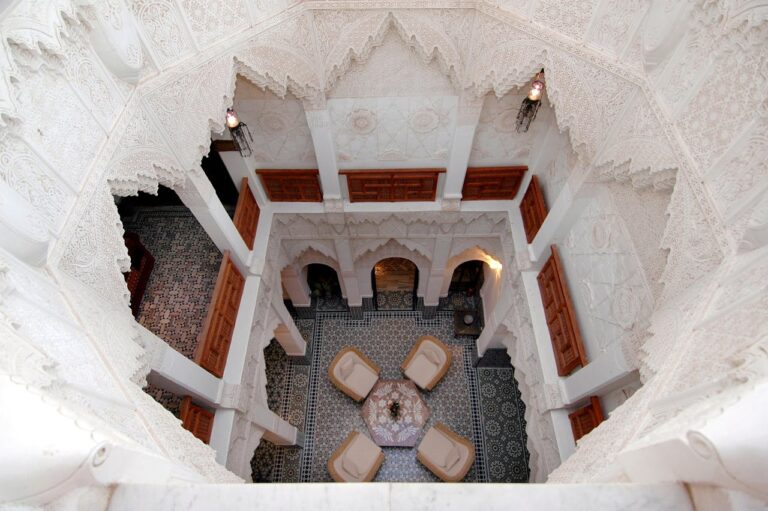
Back to riads: they’re traditional Moroccan houses built around an inner courtyard, which residents decorate with plants and mosaics. A common feature is a fountain called a sahrîdj, with great symbolic and practical meaning. In Morocco fountains represent life, because of the sacred importance of water to this people, and express the house’s life force in desert lands. So they’re essential in Moroccan homes, as well as a beautiful decorative feature.
Riads are designed according to a precise logic. From the outside they look like simple, anonymous houses with no windows onto the street. This isn’t by chance either, but an important cultural choice linked to privacy, especially women’s privacy, in Islamic society.
Life happens inside the riad, well protected from outside eyes. Riads very often have rooftop terraces, usually surrounded by high walls precisely so women can move around and work freely in that open-air space.
Besides the type of riad I’ve just described, the most common in Morocco’s imperial cities, there’s also the dar, generally simpler and without a garden, and the douiria, a smaller, self-contained version.
Aesthetically, riads are full of traditional details from Moroccan history. Walls may be finished in tadelakt, a special glossy, waterproof plaster; floors and fountains are decorated with zellige, handmade geometric mosaics. Inner windows use moucharabieh, carved wooden screens, while ceilings and walls are decorated with zouaq and gebs, two kinds of masterfully executed craftwork. And thanks to riads, you’ve learned a few Arabic words.
Since the 1970s, many riads have been restored and turned into guesthouses, partly thanks to the interest of Yves Saint Laurent and Pierre Bergé, still remembered today (as well as for their fashion house) for helping to showcase this architectural heritage.
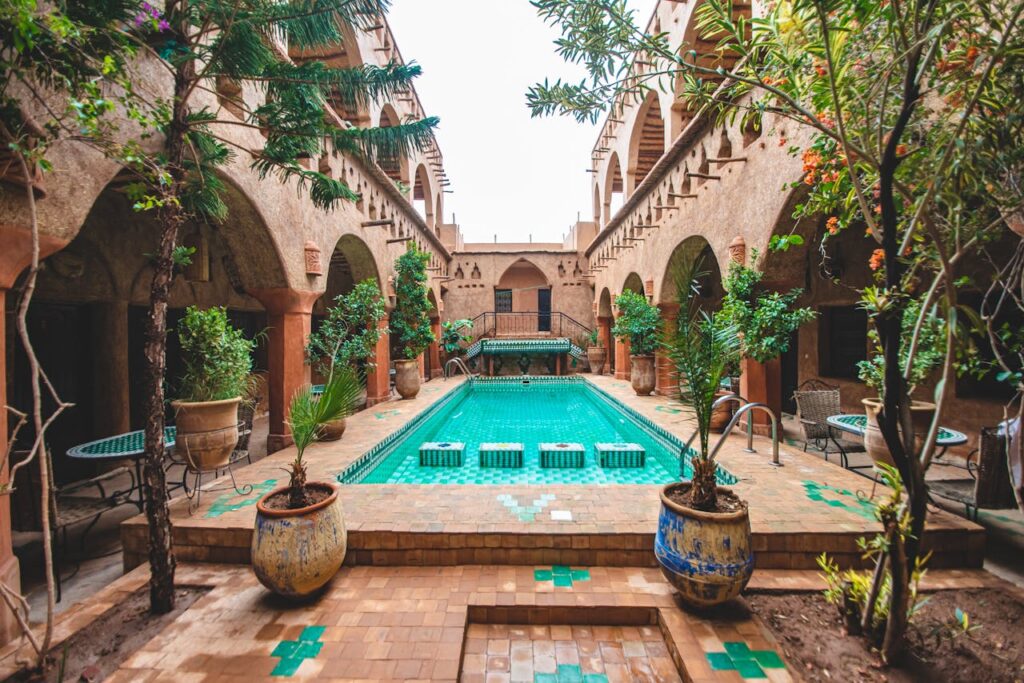
What to expect in a riad
With that background, let’s get to the heart of the experience of sleeping in a riad in Morocco. Get ready to enter a completely different world from a hotel. Riads don’t have big lobbies and hundreds of rooms, but an intimate setting with no more than 10 rooms, where every guest is welcomed in the most Moroccan way: with a family atmosphere. The staff quickly learn your names, habits and schedules, making you feel right at home.
It’s a more structured, reliable experience in an intimate setting with strong ties to tradition. That’s exactly what sets riads apart from Airbnb rentals, which in Morocco don’t always guarantee regulated standards, and you even risk getting scammed.
Riads also have the advantage of location. Whatever Moroccan city you stay in, you’ll find many riads inside the medinas. In the Mellah or Kasbah districts, you can enjoy the luxury of staying in the authentic heart of the city, turning your stay into a true cultural immersion that welcomes you as part of the urban fabric.
Sleeping in a riad also teaches you the value of time passing slowly. An experience that, in my view, should never be missing on vacation. We rush all day, every day, and at least when we can relax, we should make ourselves slow down.
Imagine arriving at a riad in Marrakech after walking through small, lively alleys. A door opens onto a silent courtyard, and your eyes fall on Berber rugs and soft lighting. If it’s cold outside, you might even find a fire burning. Your host welcomes you with traditional mint tea, the ultimate symbol of Moroccan hospitality and social bonds. It means you’re welcome, so don’t you dare refuse it, as that would be very rude.
After this first, delightful encounter with the riad, your experience can continue with a hammam, the purification ritual deeply rooted in local culture, often available in the riad itself or nearby.
Let me add three more words to your Arabic glossary: in a traditional hammam you’ll find black soap (savon beldi), the kessa glove for exfoliation and ghassoul clay to soften the skin.
Staying in a riad respectfully: the golden rule of behavior
Staying in a riad brings you into close contact with a different culture. That’s why care and consideration matter now more than ever. Remember that for Moroccans hospitality is their greatest virtue, to be approached with modesty and respect.
Starting with your clothing, which should always be modest, especially in the medinas and near places of worship. Remember, too, that even small everyday gestures have important meaning in Arab culture. You eat with your right hand even if you’re left-handed, people greet each other with the famous Salaam alaikum, and it’s good manners to take off your shoes before entering a home. If your trip to Morocco coincides with Ramadan, avoid eating or drinking in public during fasting hours.
In Morocco, social relationships are based on behavior, which matters more to people there than the appearances we’re used to in the West. Wherever you go in, it’s always appreciated if you do so calmly, greeting people and acknowledging their presence, to create a respectful, attentive atmosphere through the way you act.
How to choose the right riad
I won’t go into the details of choosing the right riad here, because we’ll do that together, in a personalized way, during the planning stage. But I want to tell you now that I always make a point of selecting riads in easily accessible spots in the medina, avoiding places that are too hard to reach, especially if you’re carrying heavy luggage.
I usually choose a riad with a rooftop terrace, so you can have breakfast outdoors and admire the sunset over the city in the evening, whether your room is on the ground floor or upstairs.
Lisa